What is a LIMS? Meaning, uses and where LIMS is going
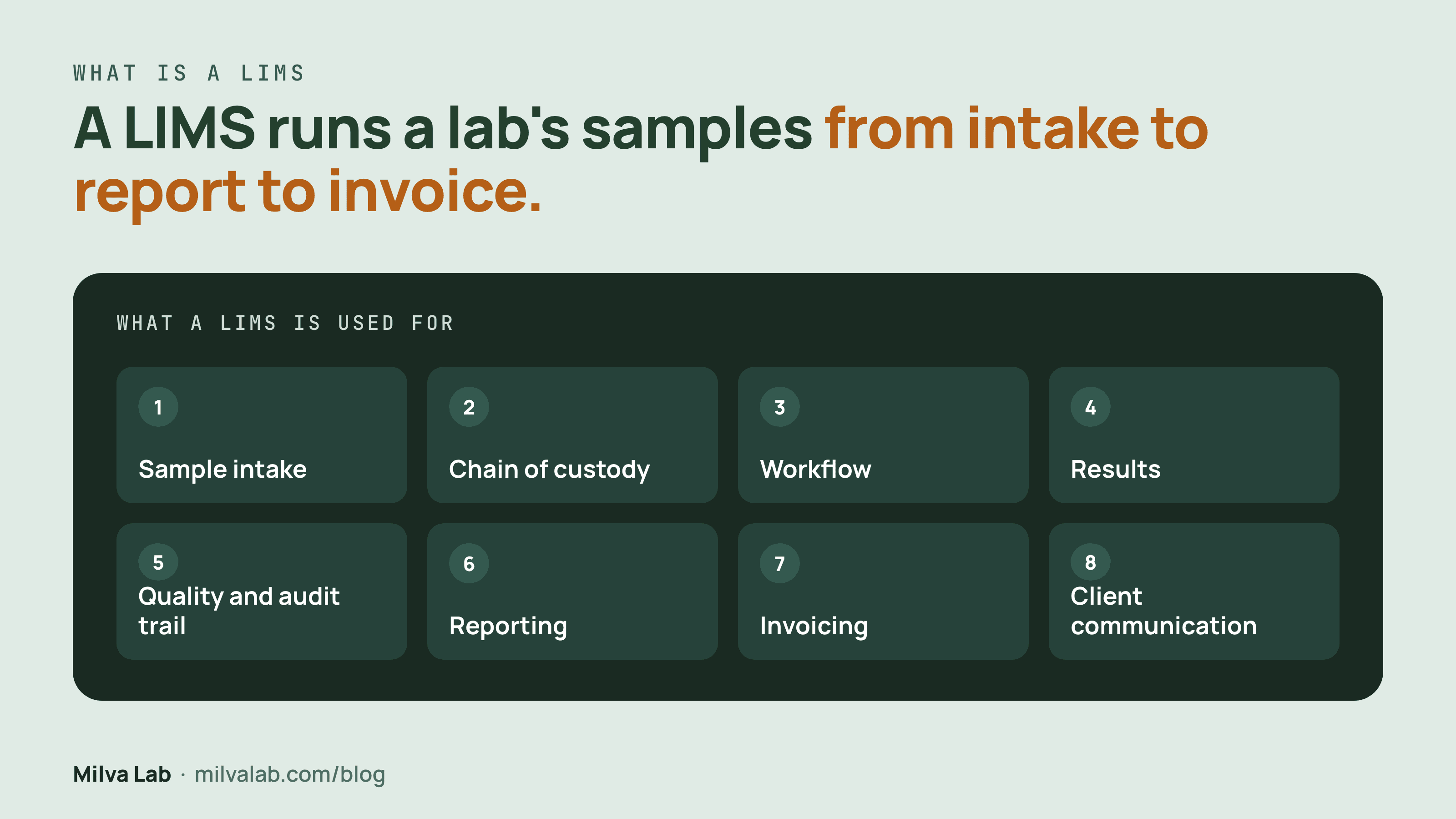
A LIMS (laboratory information management system) is software that runs a lab's samples from the moment they arrive to the moment the report and invoice go out. It records every sample, who handled it, which tests were run and what the result was, and keeps that record ready for audits. A modern, cloud-based LIMS also covers the commercial side: how clients order, follow their samples and receive their reports.
What does LIMS stand for?
LIMS stands for laboratory information management system. You will also see it called a lab system, a lab management system or lab management software. In clinical settings the term LIS (laboratory information system) is common. The names overlap, and most buyers searching for any of them want the same thing: one place where the lab's samples, results and paperwork live.
What is a LIMS used for?
A LIMS is used to know where every sample is, what happened to it, and what the lab can now report and bill. In practice that means eight jobs:
- Sample intake. Clients or field staff place a digital order. The lab receives complete data instead of a half-filled paper form.
- Chain of custody. Every handoff is recorded with who, when and where, so the sample's history is never a reconstruction.
- Workflow. Analyses are assigned, the backlog is visible, and the lab sees Monday's volume before Monday arrives.
- Results. Results are entered or imported, checked and approved by the right person.
- Quality and audit trail. Changes are logged. That supports the record-keeping expected under standards such as ISO/IEC 17025, and it means an audit does not turn into a weekend of assembling files.
- Reporting. The technical report and the client report come from the same result.
- Invoicing. The invoice is generated when the report is approved, not when someone finds time.
- Client communication. Clients see status themselves instead of calling to ask.
If your lab still runs on paper requisitions, a shared spreadsheet and email, you already do all eight jobs. A LIMS does them in one place.
How is a LIMS different from other lab systems?
| System | What it manages | Where it stops |
|---|---|---|
| Excel and folders | Anything you build into it | Breaks when two people edit at once, has no audit trail, and nobody can see status without asking |
| LIMS | Samples, workflow, results, reports, chain of custody | A traditional LIMS often stops at the lab's own walls |
| ELN (electronic lab notebook) | Experiments and research notes | Built for research, not for high-volume sample flow |
| LIS | Patient and clinical lab workflows | Built for clinical settings, not for environmental or building testing |
| Accounting or CRM | Customers and money | Does not know what happened to the sample |
The gap in that table is the one most testing labs feel: the lab system knows the sample, the accounting system knows the money, and a person in between retypes.
What is a commercial LIMS?
"Commercial LIMS" is used in two ways, and it helps to separate them.
- A commercially sold LIMS, as opposed to open-source software or a system a lab builds itself.
- A LIMS for commercial labs, meaning labs that sell analyses to external clients. This is not the same as a "commercial laboratory" in the sense of a big for-profit chain.
When we say commercial LIMS at Milva Lab, we mean a LIMS with the commercial layer built in: clients order digitally, receive a branded report, and the invoice follows the approved result. Customers can be grouped, each group with its own price, and the lab can see who orders and who uses the customer app. It is still a LIMS. It just does not stop at the lab door.
How should you think about a LIMS in the years ahead?
Four shifts separate a LIMS bought today from one bought ten years ago.
1. Cloud-based, not a server in the cupboard. A cloud or SaaS LIMS runs in the browser. There are no servers to maintain and no upgrade project every few years. (More in SaaS LIMS: what it is and why labs are moving to it.)
2. Simple to use, simple to start. A LIMS that only the quality manager can operate gets worked around. Look for a system your lab assistants can use, and a start that happens in steps while the lab keeps running: typically live within a couple of months, not a year-long project.
3. Not only internal processes. The old question was "how do we run the lab better?" The new one is also "how easy are we to buy from?" Damage firms, consultancies and property managers compare labs, and the lab that lets them order, follow status and receive a branded report without a phone call is the easier one to choose again.
4. A view of where your work comes from. Which customer groups order the most? Who stopped ordering? What does each group pay? A LIMS that knows your customers helps you add samples and revenue deliberately, instead of finding out at year-end. We never promise customers, and no LIMS can. What we focus on is the customer experience. The labs we work with expect more customers and more samples per customer, because their clients get more value and ordering is easy.
Does your lab need a LIMS?
Five signs that spreadsheets and paper have reached their limit:
- Two people edit the same sheet and one overwrites the other.
- Monday's backlog from the weekend's field work arrives as a surprise (we call it the Monday Avalanche).
- Requisitions arrive with missing or unreadable details and someone retypes them (Messy Requisitions).
- Clients phone to ask where their results are (Client Friction).
- Approved reports wait days for an invoice, and you cannot say which customer groups order more or less than last year.
Two or three of these means the cost of not having a LIMS is already visible. Small labs hit them too: see LIMS for small laboratories.
How do you choose a LIMS? Five questions
- Is it built for a lab like yours? A system made for environmental and building investigation labs fits their workflows better than a general system you configure for months.
- How long to go live, and what is included? Ask about data migration and onboarding in writing.
- What does it cost as you grow? Per-user fees punish adoption. Pricing that follows your sample volume does not. (See LIMS pricing and cost and Milva Lab's published pricing.)
- Can your clients order and follow samples without calling?
- Where does your data live, is it GDPR compliant, and can you take it with you?
Comparing vendors? Start with top LIMS systems and vendors. Want the full case for the investment? Read the benefits of a LIMS.
Key takeaways
- A LIMS runs a lab's samples from intake to report to invoice and keeps the record.
- It is used for intake, chain of custody, workflow, results, audit trail, reporting, invoicing and client communication.
- A commercial LIMS adds the client side: digital ordering, branded reports, invoicing and customer groups with their own prices.
- Choose cloud-based, simple to start, priced to follow your volume, and built for your kind of lab.
- A LIMS makes you easier to choose and gives you a view of your customers. We never promise customers: we focus on the customer experience, and the labs we work with expect more customers and more samples per customer because ordering is easy and clients get more value.
Book a 30-minute demo and we will show an order, a report and an invoice from a lab like yours. Book a demo
Not ready to talk? See our published pricing, try the price calculator or read what a LIMS really costs.
Frequently asked questions
What does LIMS stand for?
LIMS stands for laboratory information management system: software that manages a lab's samples, workflows, results and records.
What is the difference between a LIMS and an ELN?
A LIMS manages samples and the flow from intake to report. An ELN (electronic lab notebook) records experiments and research notes. Testing labs with high sample volumes usually need a LIMS first.
What is a commercial LIMS?
A LIMS that includes the commercial layer: clients order and follow samples digitally, receive branded reports, and the invoice follows the approved result. It is not the same as a "commercial laboratory".
Can a small lab use a LIMS?
Yes. A small lab is ready when paper and spreadsheets start costing more than they save. The right system starts simple and grows with your volume. See LIMS for small laboratories.
How long does it take to start using a LIMS?
It depends on scope and data. With Milva Lab you go live in steps, typically within a couple of months, while the lab keeps running.
Free 2-minute check
Where is manual work holding back your growth?
Five questions on quotes, status calls, invoicing, and reporting. See where your lab loses time and revenue to manual steps.
Get new articles by email
One short email when we publish a new article or white paper. No spam.

Martin Mikkelsen
CCO, Milva Lab