LIMS for small laboratories: start small, grow without switching
A small laboratory is ready for a LIMS when paper and spreadsheets cost more than they save: lost samples, double typing, clients phoning for status, invoices that wait. The right LIMS for a small lab is simple to start, has no per-user fees, is priced to follow your sample volume and revenue, and grows with you, so you never switch systems because you succeeded.
When is a small lab ready for a LIMS?
There is no magic sample count. Look for these moments instead:
- Two people edit the same spreadsheet and one change disappears.
- The weekend's field samples arrive Monday and nobody saw them coming.
- Requisitions come in on paper or as PDFs and someone retypes them.
- Clients call or email to ask where their results are.
- An approved report sits for days before the invoice goes out.
If you recognise two or three, the cost of waiting is already visible. A small lab feels it more, because the same few people do the science, answer the phone and send the invoices.
What should a small lab look for in a lab system?
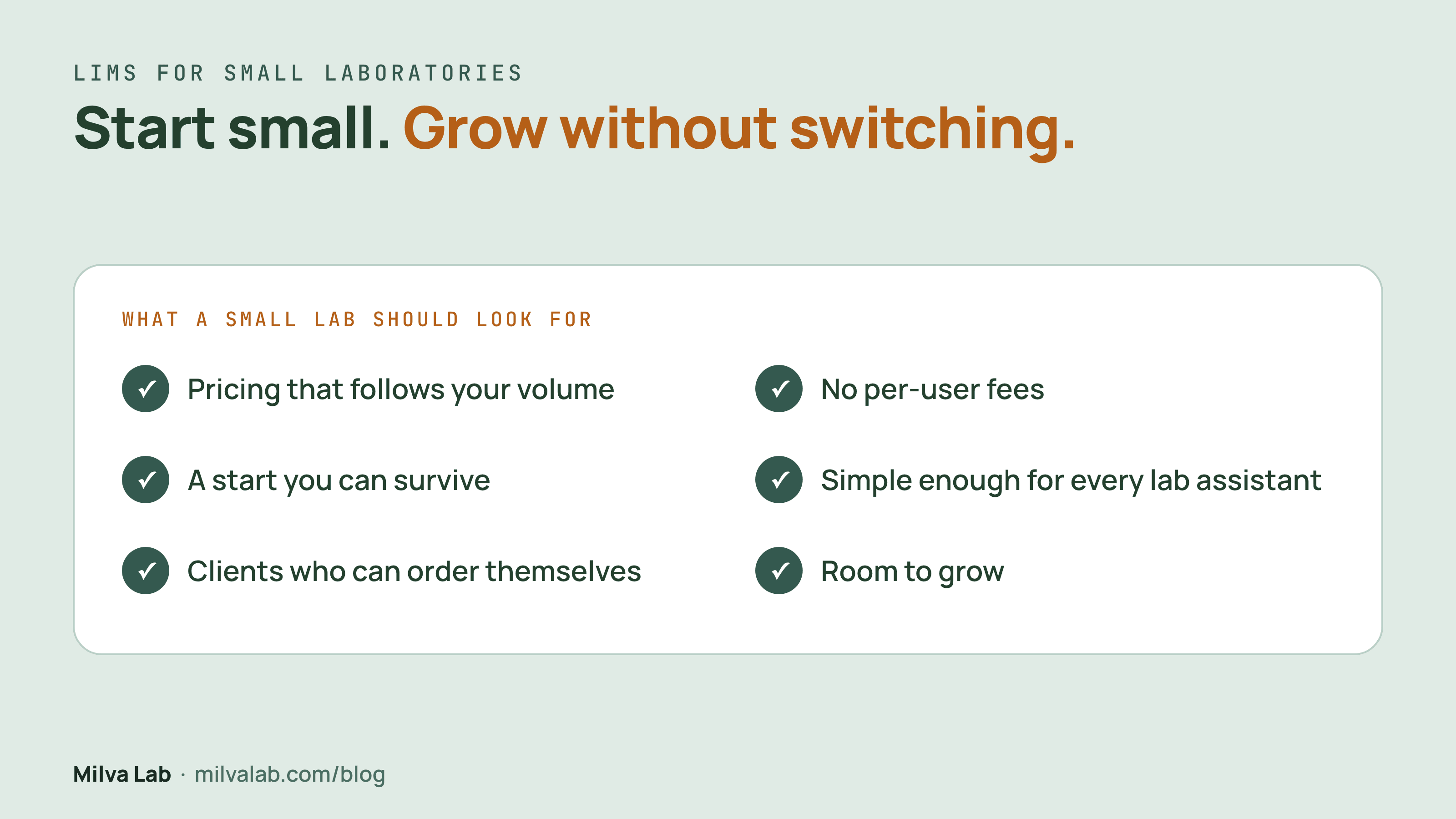
Pricing that follows your volume. A small lab does not want to pay for the volume it does not have yet. Look for a price per sample that falls as volume grows, not a large fee for a size you hope to reach.
No per-user fees. In a small lab everyone does a bit of everything. When each login costs money, people share one, and you lose the record of who did what. Unlimited users keeps the audit trail honest.
A start you can survive. Look for a system that goes live in steps while the lab keeps running, with data migration included in onboarding. A small lab cannot stop for six months.
Simple enough for every lab assistant. If only one person can operate it, it will be worked around.
Clients who can order themselves. The fastest way to lighten a small team is for clients to place complete orders and check status without calling.
Room to grow. Ask what happens at ten times your volume. If the answer is "switch to our enterprise product", keep looking.
Does a small lab need a different LIMS from a large lab?
Less than vendors suggest. The jobs are the same (see what a LIMS is and what it is used for). The difference is in pricing, rollout and how much configuration you can afford.
| Small lab | Large lab | What stays the same | |
|---|---|---|---|
| Pricing | Should start low and follow your sample volume | Volume discounts matter | No per-user fees limiting adoption |
| Rollout | Short, in steps, no stop in operations | Multi-site, longer plan | Data migration planned up front |
| Configuration | Sensible defaults | More customer groups, prices, templates | Audit trail and chain of custody |
| Clients | A handful of repeat clients ordering online | Many client groups with different prices | A customer app and branded reports |
This is why we build Milva Lab to support both small and large labs. Pricing follows your sample volume and revenue, so the system you start with is the one you keep as you grow.
What does a LIMS cost for a small lab?
It depends on the vendor, the scope and the rollout. Read LIMS pricing and cost for the cost lines to ask about, and use the price calculator to see per-sample rates by volume.
What are the common mistakes small labs make?
- Buying an enterprise system. Months of configuration for features you will not use.
- Ignoring the client side. A LIMS that fixes the bench but leaves ordering and invoicing in email fixes half the problem.
- Underestimating migration. Old samples, clients and price lists need to come across. Ask who does it and whether it is included.
- Choosing on price alone. The cheapest licence with the longest implementation is not the cheapest system.
How does Milva Lab fit a small lab?
Milva Lab is a LIMS for environmental and building investigation labs, with the commercial layer built in: a customer app where clients order and follow samples, a branded report, and an invoice that follows the approved report. The pricing is published on the pricing page. For the Core plan, which starts with one lab:
- Year 1: from EUR 6,699 (50,000 kr.), with onsite onboarding included. Travel expenses are extra.
- From year 2: from EUR 3,350 a year (25,000 kr.).
- Per sample: EUR 3 (22 kr.) for your first 8,000 samples a year, falling in bands to EUR 2. The price calculator shows the total by volume.
- Minimum: 200 samples a month.
- Unlimited users, dedicated support, free updates, cloud infrastructure and daily data backups on every plan.
You go live in steps, typically within a couple of months, while the lab keeps running. A data migration service is available for labs moving from Excel or an older LIMS. Larger and multi-site labs use the Enterprise plan.
Key takeaways
- A small lab is ready for a LIMS when paper and spreadsheets cost more than they save, not at a fixed sample count.
- Look for pricing that follows volume, unlimited users, a start in steps and a customer app.
- Small and large labs need the same jobs done. The difference is pricing, rollout and configuration.
- Pick a system you will not need to switch when you grow.
Book a 30-minute demo and see an order, a report and an invoice from a lab like yours. Book a demo
Frequently asked questions
Is a LIMS worth it for a small lab?
Yes, once manual work costs more than it saves. Small labs often gain the most because the same few people do the science, the admin and the client calls.
How many samples do I need before I get a LIMS?
There is no fixed number. Watch for lost samples, double typing, status calls and late invoices. Those matter more than the count.
Can a small lab use a cloud LIMS?
Yes. A cloud (SaaS) LIMS needs no servers or IT staff on your side. See SaaS LIMS.
Will I outgrow the system?
Not if pricing and configuration scale with you. Ask the vendor what changes at ten times your volume.
Do I need an IT person to run a LIMS?
Not with a cloud LIMS. You need someone in the lab who owns the setup, but the vendor hosts and updates the software.
Free 2-minute check
Is your lab ready to switch LIMS?
Five questions on where your data lives, how your setup is documented, and how a move could happen in steps.
Get new articles by email
One short email when we publish a new article or white paper. No spam.

Martin Mikkelsen
CCO, Milva Lab