
LIMS integration: what to connect and what to ask before you buy
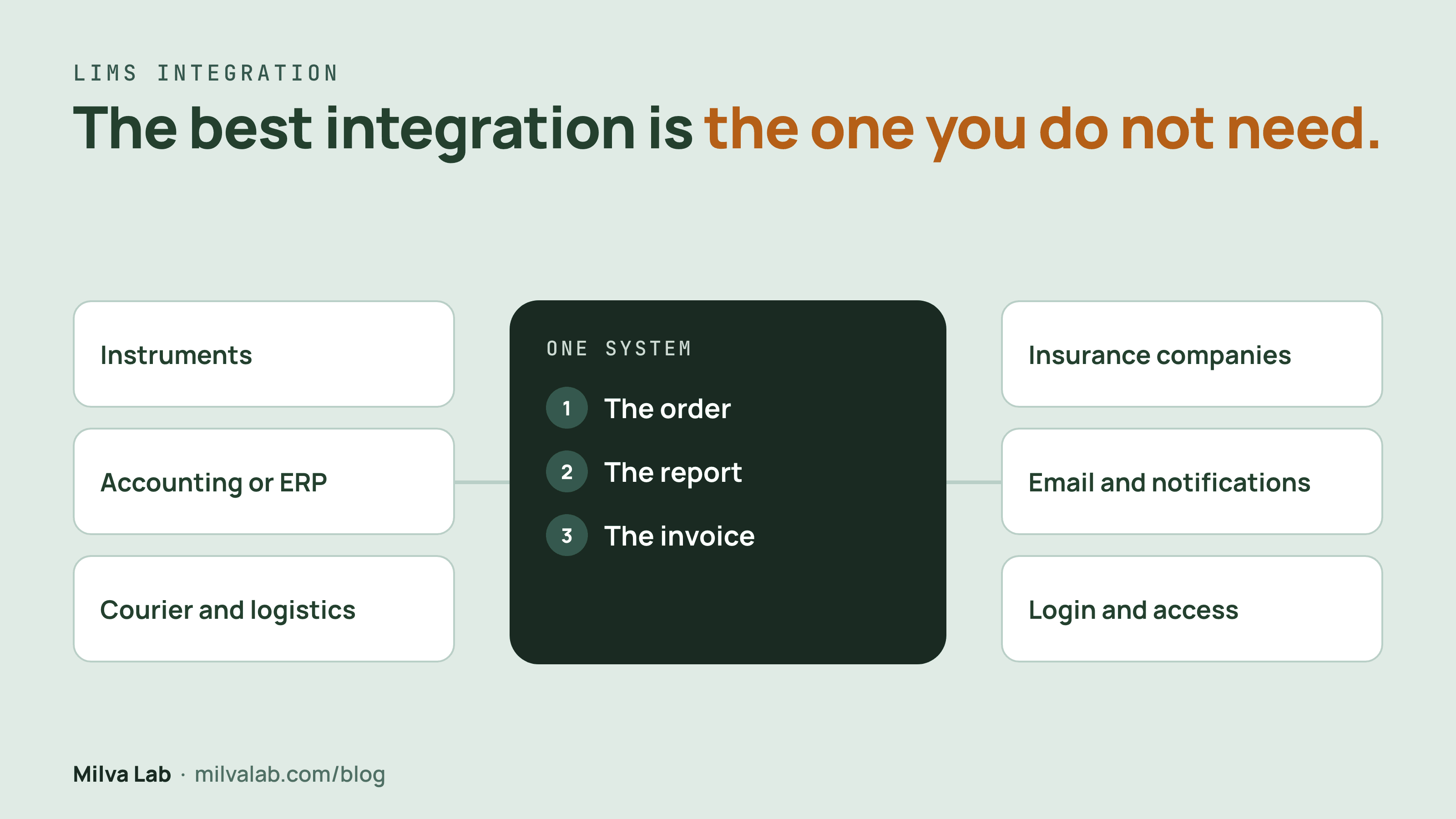
LIMS integration means connecting the LIMS to the other systems your lab uses: instruments, accounting or ERP, client ordering, couriers and email. The best integration is the one you do not need, because the order, the report and the invoice already live in one system. For everything else, ask the vendor what is standard, what is custom, who builds it and who pays when it breaks.
What can you integrate a LIMS with?
| Integration | What it does | Question to ask |
|---|---|---|
| Instruments | Results flow from analysers into the LIMS without retyping | Which instrument formats are supported? Who builds the connection? |
| Accounting or ERP | Invoices and customer data move to finance | Is the invoice generated in the LIMS, and which accounting systems are supported? |
| Client ordering | Clients place orders that become lab work | Is there a customer app, or only an internal order form? |
| Courier and logistics | Pickup and delivery of samples | Which couriers are connected? Can clients book pickups? |
| Insurance companies | Orders, results and documentation reach the insurers your clients work with | Which insurers can be connected, and what is shared? Who controls access? |
| Email and notifications | Status updates reach clients automatically | Are notifications built in? |
| Login and access | Single sign-on and role control | Are roles and access rules configurable? |
| Data export and reporting | Data goes to dashboards or analysis | Is there an API or a standard export? |
Which integrations do you actually need?
Start from the jobs, not from the list of connectors. The expensive integrations are usually the ones that exist to patch a gap:
- If your order, report and invoice live in three systems, you will pay to connect them, and pay again when one changes. A LIMS with the commercial layer built in reduces that: the client orders in the customer app, the lab works the order, and the invoice is generated from it when the report is approved.
- If results are typed in from instruments by hand, an instrument connection is worth scoping. It is a real saving and a real risk, so ask for a reference.
- If your finance team needs invoices in the accounting system, check how the invoice gets there and in what format.
What should you ask a vendor about integration?
- Which integrations are standard, and which are projects? Get the answer in writing.
- Who builds and maintains them? And who pays when an upstream system changes?
- Is there an API? Is it documented, and are there limits?
- What happens to data in transit? Is every transfer logged?
- How long do integrations take, and are they included in onboarding?
- Can I see one working with a lab like mine?
What is the hidden cost of LIMS integration?
The licence rarely shows it. Integration projects can take longer than the LIMS rollout itself, depend on third parties and need maintenance after every update. Add them to the three-year cost, as described in LIMS pricing and cost.
How does Milva Lab handle integration?
Milva Lab is built so that the main commercial flow needs no patching: clients order in the customer app, the lab works the order, and the invoice is generated when the report is approved. Around that flow we connect to the systems a lab already depends on:
- Your preferred courier: DHL, GLS or another. Logistics integration means samples reach the lab without chasing, using the courier you already work with. Pickup and drop points are part of the flow.
- Your accounting system: Business Central or e-conomic. Invoices from Milva Lab reach your finance system, so nothing is retyped. ERP and CRM integration is part of the Enterprise plan.
- Insurance companies. For labs whose customers include insurers, we connect to the insurance companies your clients work with, so orders and documentation reach the right people without email. We are not a claims platform, and we take no payment from insurers.
- Your own systems. Custom integrations and single sign-on are available on the Enterprise plan and are scoped and priced individually.
Everything runs in the cloud and is GDPR compliant, with a data processing agreement available on request. See pricing for what each plan includes.
Key takeaways
- LIMS integration connects instruments, accounting, ordering, couriers, insurers and notifications.
- Integrations you need to patch gaps between order, report and invoice are the ones to avoid. Milva Lab connects to your preferred courier, your accounting system and the insurance companies your clients work with.
- Ask what is standard, who builds it, who maintains it and what it costs.
- Add integration to your three-year cost.
Related: SaaS LIMS · Top LIMS systems and vendors
Frequently asked questions
What is LIMS integration?
Connecting a LIMS to other systems in the lab: instruments, accounting or ERP, client ordering, couriers, email and data export.
Does a LIMS integrate with accounting software?
Many do, in different ways: some generate the invoice in the LIMS, others export data. Ask which accounting systems are supported and who builds the connection.
Do I need to integrate instruments with a LIMS?
If results are typed by hand, instrument integration saves time and reduces errors. Ask for a reference lab with the same instruments.
Does a LIMS have an API?
Some do. Ask whether it is documented, what it covers and whether there are limits.
How long does LIMS integration take?
It depends on the system and who builds it. Ask for an estimate in writing and whether it is part of onboarding.
Free 2-minute check
Is your lab ready to switch LIMS?
Five questions on where your data lives, how your setup is documented, and how a move could happen in steps.
Get new articles by email
One short email when we publish a new article or white paper. No spam.

Martin Mikkelsen
CCO, Milva Lab