What does an accreditation auditor actually ask for?
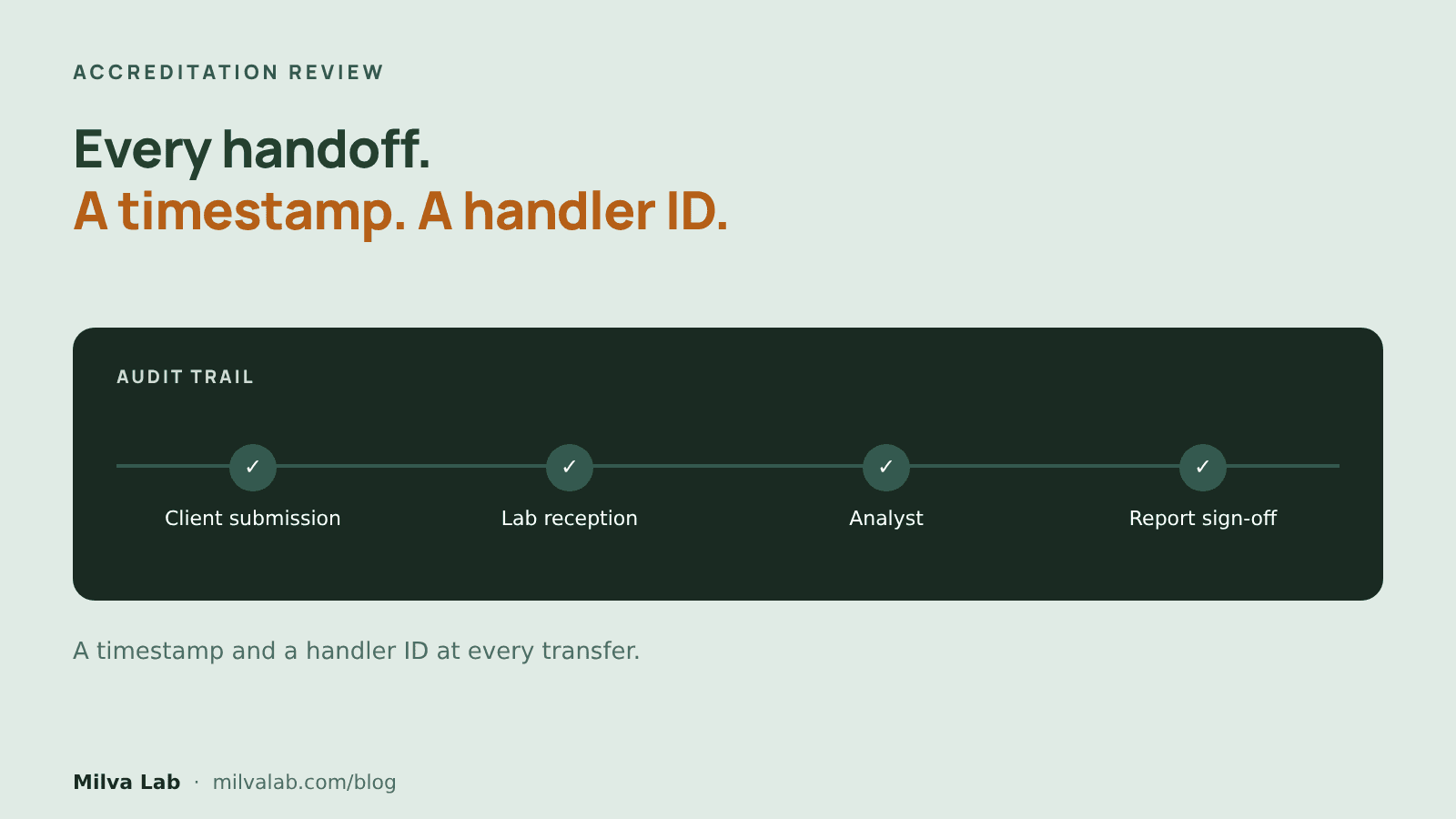
An accreditation auditor is checking one thing: who handled a sample, and when, from the moment it arrived to the moment the result went out. On paper, that record gets assembled under time pressure, from binders, signatures and memory. In Milva Lab, the audit trail is already complete, because every handoff is timestamped and logged the moment it happens.
A Quality Lead is going through the sample log three days before an accreditation review, looking for one specific handoff: who received sample 4471, and when. The paper trail shows a reception date, a technician's initials on a different form, and a gap where a condition note should be. None of it is wrong, exactly. It is just scattered across three places, and the reviewer's question was never about the lab's science. It was about whether the lab can show its work.
What does an accreditation auditor actually ask for?
The question behind every audit is some version of the same one: what happened to this sample, who handled it, and when. An auditor is not asking whether the lab is good at analysis. They are asking whether the lab can prove, step by step, that a result traces back to a real sample through a documented, unbroken chain. A lab that answers with a confident binder still has to produce the binder. A lab with the record built in already has the answer ready.
Where does the record usually break down?
- A handoff signed on paper hours after it actually happened, once someone remembers to fill in the form
- A condition note at reception that exists in someone's memory but not in writing
- Handler names spelled differently across the requisition, the lab log and the report
- A binder assembled the week before the audit from whatever paperwork can still be found
What does an audit-ready record look like instead?
Milva Lab builds the chain of custody as the sample moves, not afterward. Every handoff, client submission to lab reception, reception to analyst, analyst to report sign-off, is logged with a timestamp and a handler ID at the moment it happens, and condition is flagged at reception instead of reconstructed from memory a week later.
- Timestamp and handler ID logged at every transfer, from first client contact to final sign-off
- Condition flags captured at reception, in writing, at the time
- A complete record pulled in one click, instead of assembled from paper and memory
- Every approved result released from the lab's own record, with the chain of custody behind it
Does Milva Lab replace the lab's own accreditation?
No. Accreditation stays the lab's own, and so does the judgment behind every result. What changes is what happens when the question comes: instead of reconstructing the record under time pressure, the lab hands over a record that was already complete.
If your lab's own audit week still means a scramble through binders and half-remembered handoffs, it is worth seeing what the record looks like when it is built as the work happens instead of reconstructed afterward. Related reading: how long chain of custody documentation should actually take.
Frequently asked questions
What does an accreditation auditor actually ask for?
A step by step record of what happened to a specific sample: who handled it, when, and under what condition, from the moment it arrived to the moment the result went out. Not an opinion of the lab's science.
Does Milva Lab manage or issue the lab's accreditation?
No. Accreditation remains the lab's own. Milva Lab builds the audit trail an auditor checks against, so the record exists before the question is asked.
What gets logged at each handoff in Milva Lab?
A timestamp and a handler ID at every transfer, from client submission to lab reception, reception to analyst, and analyst to report sign-off, with condition flagged at reception.
Can a lab produce a full audit record on short notice?
Yes. Because every handoff is logged as it happens, the complete record is a one-click export rather than something assembled from paper and memory before the review.
Free 2-minute check
How exposed is your lab's next audit?
Five questions on intake, requisitions, client updates, and chain of custody. See where an auditor would look first.

Martin Mikkelsen
CCO, Milva Lab