LIMS software for asbestos testing labs: what to look for
A LIMS for an asbestos testing lab should keep every sample in an investigation linked to one case, build the chain of custody automatically from the moment a sample is collected, let clients follow their samples without phoning, and turn approved results into a report and an invoice without retyping. Generic LIMS tools can do parts of this. A system built for environmental and building investigation labs does it as one connected workflow.
An asbestos investigation rarely means one sample. A single building can produce a long list of samples taken in different rooms by a field investigator, each with its own location, material and result. The lab has to keep them together as one case, keep each sample traceable, and answer a client who needs the result to decide what happens next. That is the situation a LIMS for an asbestos lab is measured against.
What makes an asbestos testing lab different from other labs?
Asbestos work is driven by field investigations. Samples are collected on site and arrive at the lab in batches, often with requisitions that are incomplete or on paper. Clients are typically consultancies, damage firms, contractors or property managers who are waiting for results to make a decision. The lab's day is therefore shaped by intake, traceability and communication as much as by the analysis itself.
What should a LIMS for an asbestos lab cover?
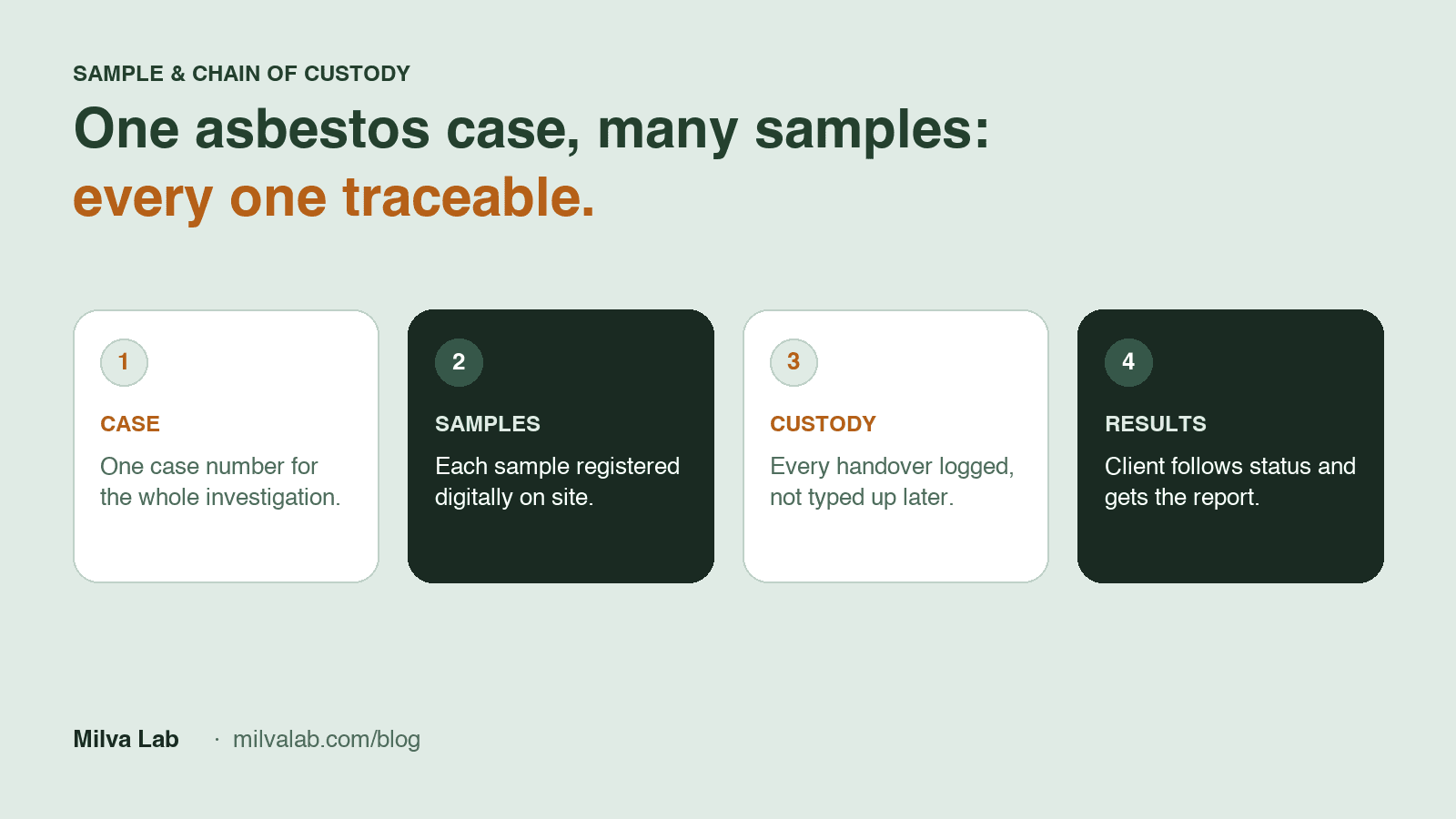
- One case, many samples: all samples from an investigation grouped under one case number, with location and material recorded per sample.
- Digital intake: field investigators register samples on site, so the lab receives complete information instead of retyping a requisition.
- Chain of custody: every handover from collection to analysis is logged as it happens, so the documentation exists when a client or auditor asks for it.
- Lab workflow: a clear view of what has arrived, what is in analysis and what is due, including the pile that arrived over the weekend.
- Client visibility: clients can see the status of their own samples and download reports, so the team is not interrupted by status calls.
- Reporting and invoicing: results are approved once, and the report and the invoice follow from the same data.
Why does chain of custody matter more with asbestos samples?
A result is only as useful as the proof of where the sample came from and who handled it. When a client relies on a result for a decision, or an auditor asks how a result came about, a chain of custody that was built as the sample moved is easier to trust than one reconstructed afterwards. The point of a digital chain of custody is that the record is a by-product of the work, not an extra task.
How do you test whether a LIMS fits an asbestos lab?
Ask every vendor to show three real situations from your own lab, in the system and not on slides: a batch of samples from one investigation arriving on a Friday afternoon, a client asking where their samples are, and an approved result becoming a report and an invoice. If any step needs a separate tool or manual re-entry, you have found where the time will keep going.
If you want a broader checklist, read our buyer's guide for choosing a LIMS for environmental and building testing labs. If you want to see where paper intake and manual status updates could expose your lab, the free audit exposure check takes a few minutes.
Frequently asked questions
What should a LIMS for an asbestos testing lab do?
It should group all samples from an investigation under one case, support digital intake from the field, build the chain of custody automatically, give clients a view of their samples, and produce the report and invoice from the same data.
Can a general-purpose LIMS be used for asbestos testing?
Parts of the work can be covered, but a system built for environmental and building investigation labs handles the field-to-lab-to-client workflow as one connected process instead of leaving gaps that are filled by hand.
Why is digital chain of custody useful for an asbestos lab?
Because the record is built as samples move, it is complete when a client or auditor asks for it, and nobody has to reconstruct it afterwards.
Free 2-minute check
How exposed is your lab's next audit?
Five questions on intake, requisitions, client updates, and chain of custody. See where an auditor would look first.

Martin Mikkelsen
CCO, Milva Lab