Should a testing lab build its own LIMS, or buy one?
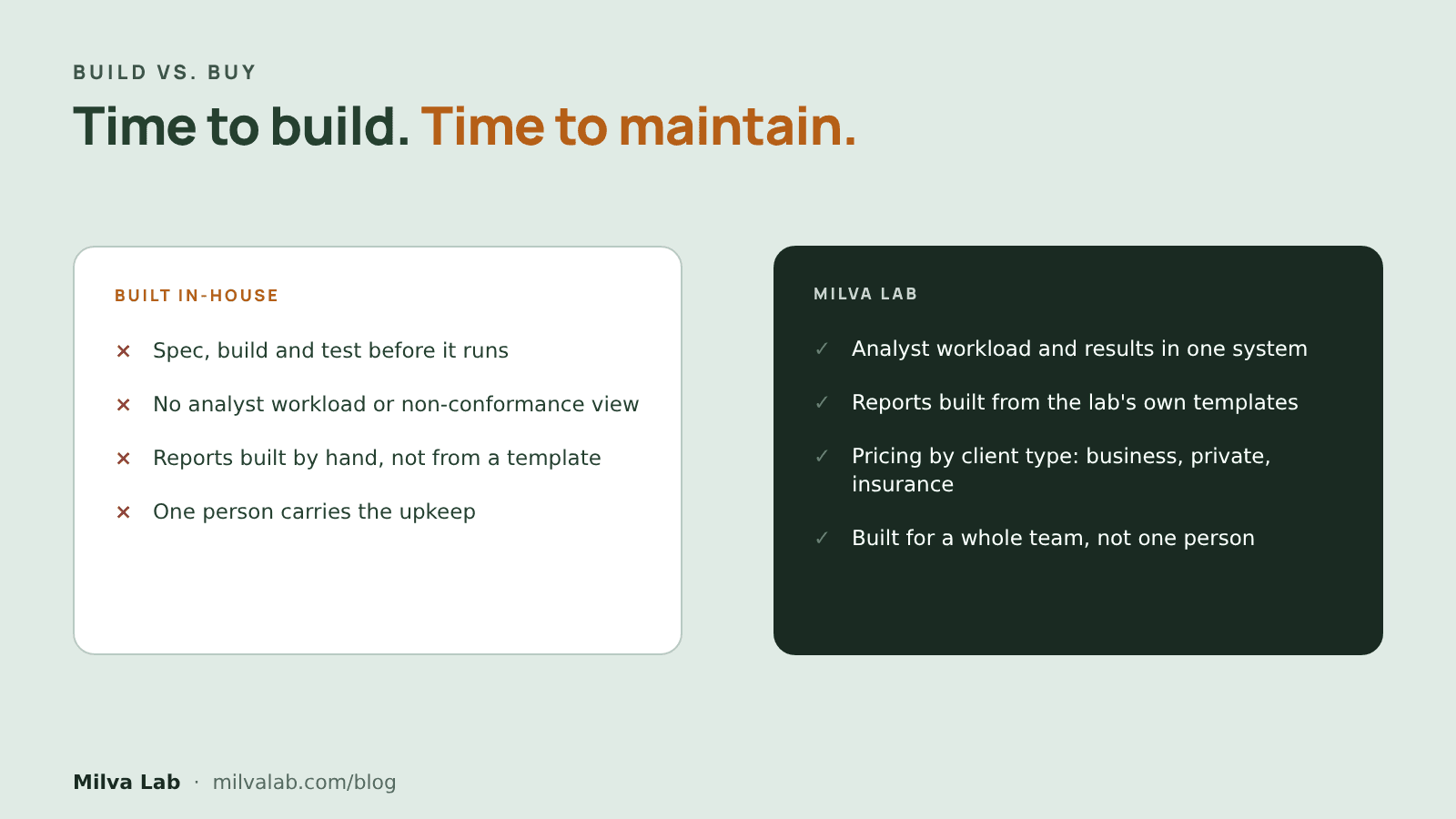
Building a LIMS in-house, even with AI coding tools, still means specifying requirements, building the system, and testing it before it can run a single sample: time that comes out of running the lab, not time saved. A testing lab also needs chain of custody that holds up to audit, a whole team working in it at once, a customer-facing app, and reporting and invoicing that stay accurate as the lab grows. Securing, certifying, and maintaining that software is an ongoing cost for as long as the lab runs it, which is why most labs weighing this trade end up buying from a company whose only job is building it.
A lab owner decides to build the lab's sample system in-house, using an AI coding assistant to move faster than hiring a developer would. Before it can run a single sample, someone still has to write down what the lab actually needs: which sample types, which analyses, how chain of custody has to hold up for accreditation, how invoicing should follow a signed-off result. That specification work, and the building and testing that follows it, is real time, spent by the people who would otherwise be running samples or talking to clients.
What does it actually take to build a LIMS in-house?
An AI coding assistant can write code quickly, but it cannot sit in on the conversation about what the lab's accreditation body expects from a chain of custody record, or decide how an invoice should be triggered. Someone on the lab's own team still has to work that out, build it, test it against real sample flows, and fix what breaks, before any of it is ready to run a single sample. None of that happens on the side. It happens instead of the work the lab is actually there to do.
Where does an in-house build start to cost more than it saves?
Once a lab is handling around 500 samples a month, manual reconciliation, whether it happens in a spreadsheet or in a homegrown system, starts costing more time than it saves. A few questions tend to surface the gap before that point does. What happens when two technicians work in the system at the same time and one overwrites the other's entry? What happens on the Monday after a busy field weekend, when the backlog is already sitting in the system before anyone has looked at it? And when an accreditation auditor asks for a chain of custody record built in a tool only one person understands, who answers that if that person is on leave, or has moved on?
What does an in-house build still require, underneath the AI?
An AI coding assistant removes the need to hire a developer. It does not remove the need to specify, test, secure, and keep running what gets built, or the time that takes from the people doing it alongside their regular work. Veracode's 2025 analysis of AI-generated code found that close to half of it introduced a security flaw, and Stack Overflow's 2025 developer survey, with responses from more than 49,000 developers, found that 66 percent call AI output that is ‘almost right, but not quite’ their biggest frustration with the tools. For an internal draft, almost right is often good enough. For a record an auditor can ask to see a year later, it is not.
Handling client samples and accreditation records also pulls in the parts of running software that AI does not touch: hosting, backups, access control, and in many cases a formal certification such as ISO 27001, which typically takes three to twelve months the first time and a yearly audit after that to keep. A 2026 survey of more than 800 enterprise software builders by Retool found that over a third had already replaced a SaaS tool with something built in-house, while naming security and compliance concerns, and ongoing maintenance, among the top reasons those projects stall before reaching production. In the report's own words: time saved building something can be offset by time lost maintaining it.
What does a lab get from a purpose-built system that an in-house build does not?
A commercial testing lab's real requirements go well past tracking samples. Analysts need workload visibility and structured result entry, non-conformances need to be flagged and resolved without leaving the system, and reports need to come out formatted the way each client expects. Client accounts need their own pricing, whether that is a business client, a private client or an insurance case, and invoices need to follow automatically once a result is signed off. Milva Lab's commercial LIMS is built as one system that covers that whole list: the commercial side of running the lab and the internal lab workflow together, with its own customer app built in.
- Workload visibility and structured result entry for every analysis, not just a sample status
- Non-conformances flagged and resolved without leaving the system
- Client-specific report templates, built from the lab's own data
- Customer accounts with their own pricing, for business, private and insurance clients
- Chain of custody built as the sample moves, not reconstructed for an audit
- A system the whole team can maintain, not just the person who built it
The choice is not really about whether an AI tool can write working code. It can. The choice is whether the people running the lab spend the next year specifying, building and maintaining software, or spend it running samples and growing the client list. For most labs weighing that trade, buying from a company whose only job is building LIMS software turns out to be the straightforward answer. Our free commercial check is a two-minute way to see where manual work, in-house or otherwise, is already costing the lab time.
Frequently asked questions
Should a testing lab build its own LIMS, or buy one from a vendor?
Building it in-house, even with AI tools, still means specifying, building and testing it before it runs a single sample, time that comes out of the lab's own work. For the full requirements of an accredited testing lab, chain of custody, a client portal, reporting and invoicing, and more than one person able to maintain it, a purpose-built system from an established vendor holds up better over time.
What is the real cost of building a LIMS in-house?
Some of it shows up immediately, in the time spent specifying, building and testing before the system runs a single sample. The rest shows up later: reconciling entries two people edited at once, explaining an undocumented record to an auditor, and maintaining the system once the person who built it is unavailable.
At what point does a lab outgrow a spreadsheet or a homegrown system?
Around 500 samples a month is the point where manual reconciliation, whether in a spreadsheet or a self-built system, starts costing more time than it saves.
What does a testing lab actually need beyond an in-house build?
Workload visibility and result entry for every analysis, non-conformance handling, client-specific report templates, pricing by client type, chain of custody documentation, and a system more than one person can maintain.
Does using AI to build the software remove the security and compliance work?
No. Veracode's 2025 research found that close to half of AI-generated code introduced a security flaw, and compliance work such as ISO 27001 certification still takes three to twelve months the first time, with a yearly audit after that. AI changes how fast a first version appears, not what it takes to keep it secure and compliant, or the time it takes to build it in the first place.
Free 2-minute check
Where is manual work holding back your growth?
Five questions on quotes, status calls, invoicing, and reporting. See where your lab loses time and revenue to manual steps.

Martin Mikkelsen
CCO, Milva Lab