Chain of custody software: what a testing lab should expect
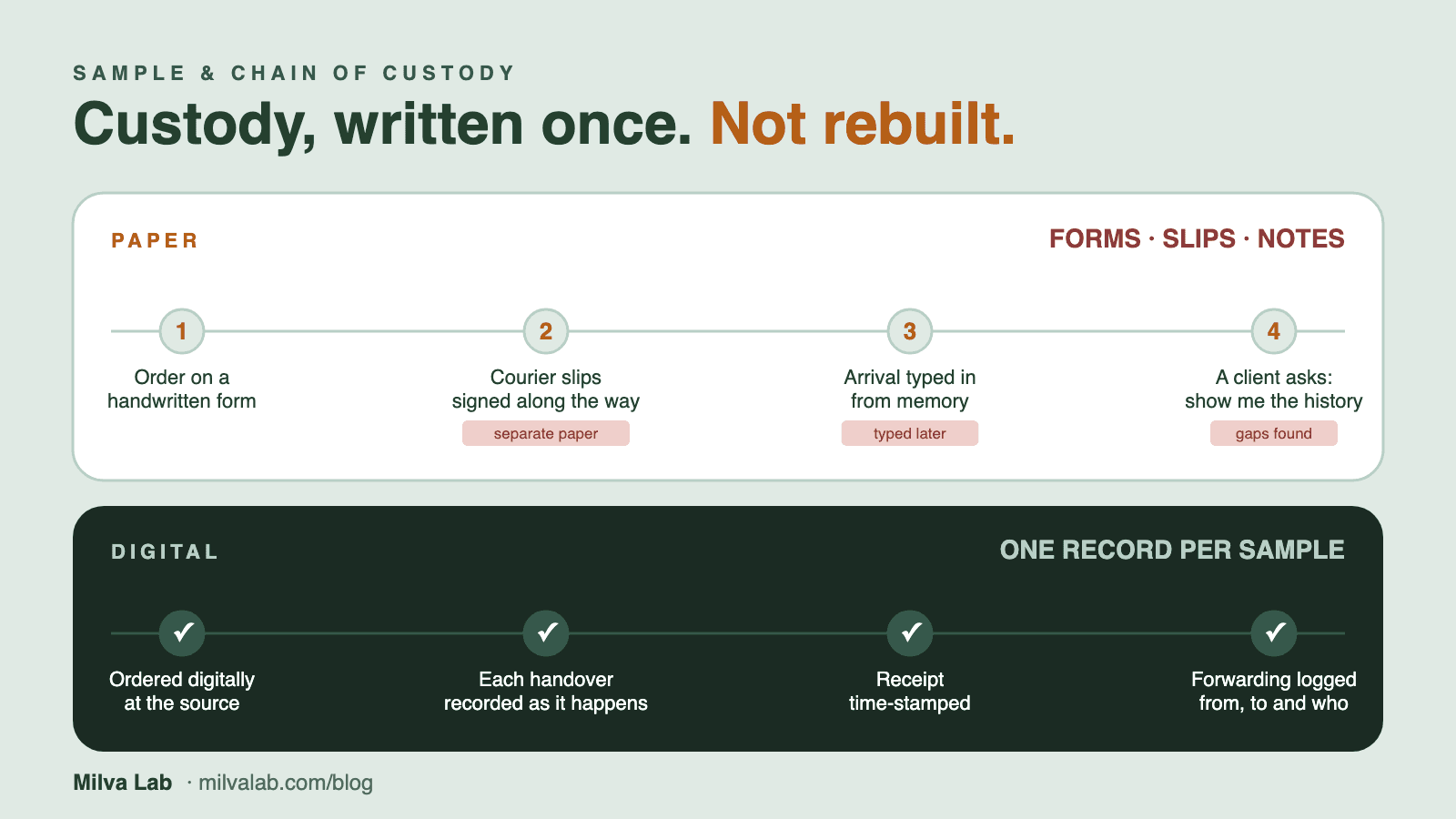
Chain of custody software records who had a sample, where, and when, from the first registration to the final report, as each handover happens. A testing lab should expect it to start at ordering, capture every handover including couriers and transfers between sites, time-stamp the receipt at the lab and show the full history on the sample without anyone typing it in afterwards. In Milva Lab the chain builds itself with every step, because intake, receipt and forwarding are all registered in the same system.
A client asks for the history of a sample from three months ago. On paper, someone digs out a form, a courier slip and a note about when the sample arrived, and hopes the three agree. With the right software the answer is on the sample's own page, in the order it happened.
What is chain of custody software?
It is the part of a lab system that keeps the record of a sample's custody: every person and place that held it, and the time each handover happened. For environmental and building testing, that record is what lets a lab stand behind a result when a client, a contractor or an auditor asks how the sample got from the site to the report.
What should it record?
- Who ordered the work and who collected the sample, with where and when
- Each handover along the way, including couriers, drop points and drivers
- When the sample was received at the lab, and at which location
- Any transfer to another site, with where it came from, where it went and who moved it
- The samples that belong to the same order, so nothing is missing from the set
- Who did each of these, so the record is a history of people and not just of states
What should you expect from it?
- It starts at ordering. A custody chain that only begins at the lab bench has already lost the first and often the most disputed link.
- Entries are made as the handover happens, by the person doing it, not typed in later from a form.
- The history is shown on the sample and on the order, readable by someone who was not there.
- Transfers between sites are recorded as transfers, with from, to and who, and a forwarded sample stays traceable.
- It is connected to the rest of the flow, so the receipt time that starts the custody record also starts the delivery clock.
Where does paper and Excel break down?
A paper form records the first signature well and everything after that poorly. Receipts are noted in a separate list, forwarding is a note in a bag, and corrections are made in whichever copy someone had at hand. The result is a record that can be assembled for an audit, but not one that is reliably complete at any given moment. The chain of custody is only as strong as its weakest entry, so gaps tend to be found when a client questions a result.
What to ask a vendor
- Does the chain start when the order is placed, or when the sample is on the bench?
- Who makes each entry, and can they do it on site from a phone?
- How are transfers between our sites recorded?
- Can I see the history of one sample, in order, on one screen?
- Is the receipt time the same time the delivery deadline is counted from?
How does Milva Lab handle it?
Orders are registered digitally by the client or by a field team, so the first entry is made at the source. The lab marks samples as received, which time-stamps the arrival and the location, and forwarding between sites is recorded with where the sample came from, where it went and who moved it. Because intake, receipt, forwarding and invoicing live in the same system, nobody has to assemble the chain afterwards. See the Commercial LIMS service page for the full flow.
Related: how a lab registers a received sample, how a lab with several sites forwards samples and the time chain of custody documentation takes.
Frequently asked questions
What is chain of custody software?
Software that records who held a sample, where and when, from the first registration to the final report, so the history can be shown on request.
Why does chain of custody matter for environmental and building testing?
Clients and auditors rely on results for decisions. A complete record of how the sample got from the site to the report lets the lab stand behind the result.
How is chain of custody different from a sample log?
A sample log lists samples. A chain of custody records every handover of each sample with who and when, so the history can be reconstructed from the record itself.
Can chain of custody software handle several lab sites?
Yes, if transfers between sites are recorded as transfers, with from, to and who. In Milva Lab forwarding is recorded that way.
Does digital intake improve the chain of custody?
Yes. The first entry is made at the source, by the person ordering or collecting, so the chain starts complete and not reconstructed later.
Free 2-minute check
How exposed is your lab's next audit?
Five questions on intake, requisitions, client updates, and chain of custody. See where an auditor would look first.

Martin Mikkelsen
CCO, Milva Lab